Friday, October 5, 2012

Fisherman's Postcard, October 5th

Cold weather finally arrived in Yellowstone. Through to the end of September, daytime highs always made it to the upper 60s, even 70s, despite overnight lows near freezing. All that changed two days ago.  
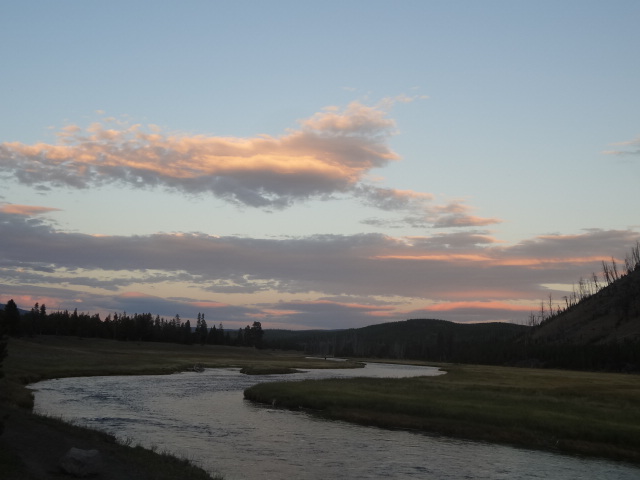
Evening over the Madison River and the Gallatin Range

Fall weather is truly here. For the next several days, daytime highs will struggle to the 40s, nighttime lows in the upper teens. Even so, it remains unseasonably dry. The last significant rain was early September, and amazingly, still no snow.
Morning on the River, Madison Campground

I have camped the past two weekends as a break from the dorm/cafeteria routine and to be closer to the fishing. A new goose down sleeping bag and plenty of layers has made it very comfortable.  Sub-freezing nights, though, will really put my equipment to the test.  

Nighttime at Madison Campground two nights ago was spectacular. Moonlight from the full moon and a starry sky illuminated National Park Mountain that towers above the junction where the Firehole and Gibbon Rivers meet to form the Madison River. A bull elk serenaded his harem starting about 4 AM, its bugling quite a sound in the middle of the night. 
Brown Trout on a streamer, Firehole River

Fishing has been both good and not so good. I have caught two of the nicest fish of the season in the past week, both large brown trout that took a streamer (Bakers Hole Bugger) bought custom-tied from Jason Davis (thanks, Jason!). One came from a classic brown trout lie (log in the water just off the riverbank, a soft pocket of water next to fast water) on the Firehole River.  

The other big trout came from Barns Pool #1 on the Madison, an iconic fishing spot just inside the Park’s west boundary where anglers go to intercept the trout running up the river out of Hebgen Lake. Anglers come from around the country to fish this in the fall. Pleasantly, it is not nearly crowded as I feared. Camaraderie comes easily among a half dozen or so anglers who take turns working down the 200 yard run of deep water, a slow dance line that follows an unwritten etiquette taking turns and not ‘sitting on the hole.’ 
Brown Trout at Barns Pool #1, Madison River

Barns Pool is top-drawer fly fishing, you really have to be on your game. Both brown and rainbow trout are to be had. Good anglers catch the fish, average anglers don’t.  Little mistakes in presentation leave you empty-handed, and the big trout are exceedingly difficult to get well-hooked and keep on the line. Two totally different techniques are employed; swinging streamers and soft hackles, or nymphing under an indicator. So far, I’d say that nymphing has the upper hand. 

Despite the two nice fish, fishing has not been what I expected for the fall, the fish elusive. I attribute it to bluebird, cloudless days and the lack of rain/snow keeping the rivers low and gin clear.  
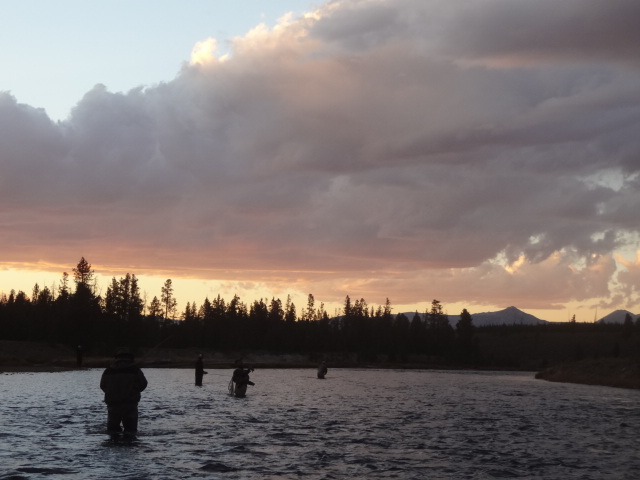
The dance line at sunset, Barns Pool on the Madison
Optimism distinguishes fishing from catching. I have two more weeks here to witness it to turn on. My dreams are of cloudy days and some rain or snow in the air.

Thursday, September 27, 2012

The End in Sight


Sorry for the long interruption. The technical glitch is solved, I can upload photos once again.
Sunset on the Madison River, below Junction Pool

September is passing in a flash. The end of my Yellowstone season is in sight, it is bittersweet. My last work day is October 14th.  I am really looking forward to being back home, and yet some of the best fishing is about to happen in these last few weeks.

Fall  color on the meadow at Whiskey Flat
Work is getting in the way of the fishing! Old Faithful becomes understaffed as the season draws to a close, so more hours of work for those of us who are left. I still manage to fish a lot by any normal standard, it’s just that there are so many fishing opportunities here.

The Park’s season is winding down too. Although Old Faithful Inn is sold-out right up until the last week, the daytime visitor traffic in the Park is way down. It is so much more enjoyable without the crowds…mid-July to mid-August bordered on the unpleasant.
Riverside Geyser eruption, Firehole River

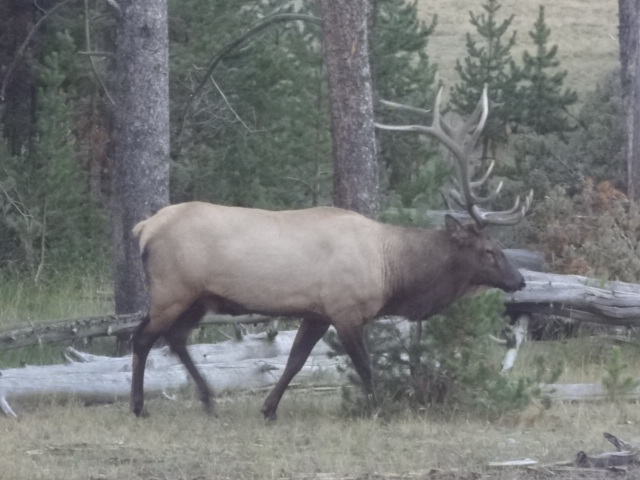
Bull Elk, Big Bend Meadow on the Madison River
A lot has happened in the past month. I fished a day with Paul  Meyer, a Trout Unlimited buddy from Michigan, the end of August. Tom Quail and Joe Swantek, fishing buddies from Michigan, were here in the Park the first week. Ted, my coworker, and I had a terrific driftboat fishing trip with a guide on the lower Madison. The elk and moose are in their rut, bugling and putting on a  show. The fall run of trout up the Madison from Hebgen Lake is just beginning. Fall is settling on the Park with golden colors and frosty mornings.

Brown Trout on a dry flay; Grasshopper Bank on the Madison
I will try to post these stories in the coming couple of weeks.

Sunday, September 2, 2012

Technical Difficulties with Blog; No Photo Upload

Sorry, there is a glitch right now in the blog website. I am unable to upload photos to go with each posting. I am working on getting that resolved.

In the meantime, I'll continue posting stories so I don't fall behind. Pretty dry without the photos, I know. Again, sorry.

See latest story below, published 9/2.

Dan

Rendezvous with Old Friends; Craters of the Moon National Monument, Idaho

I visited with our old friends from Michigan, Phil & Marg Carroll, last weekend. Phil and I worked together in the 80s/90s, and fished/hunted together. They moved to Boise Idaho about fifteen years ago. This was the first time seeing each other in over ten years.

We met halfway between Boise and Yellowstone in Arco, Idaho; about 200 miles of driving for each of us. Arco is the nearest town to Craters of the Moon National Monument. In addition to being the first city in America to get its electricity from nuclear energy (1955), it also has a KOA campground. Our reservation was guaranteed along with hot showers; wi-fi, even a swimming pool.

Getting there was interesting in itself. Over the Continental Divide at Targee Pass. Through Island Park, Idaho and along the Henry’s Fork of the Snake River, another fabled Western trout stream. Across ninety miles of treeless sagebrush on Idaho Highway 33, the only interruption a few small towns with populations of one hundred or less. Past huge expanses of hay, wheat, alfalfa fields made arable by the miracle of high plains irrigation.

Our sightseeing was at Craters of the Moon National Monument. It is another impossible landscape of bizarre geology. The site of violent volcanic activity, it is in the chain of hotspots known as the Great Rift that includes Yellowstone, its most recent eruption. Here are vast fields of lava flows, craggy cinder cones, and volcanic rubble where plants and animals somehow make this home through the wonders of ecological adaptation. We heard the Apollo astronauts trained for the moon landings here. What your eyes take in says that is entirely plausible.

We enjoyed the creature comforts of Phil and Marg’s new RV for meals, catching up on our families, hobbies, and retirement life. Good thing; my two-man tent would have been pretty cramped.

Tuesday, August 28, 2012

Heidi Went Home

Celebrating our 38th anniversary; dinner at Old Faithful Inn
Heidi flew home from Bozeman on August 15th, about a month early. She never got her work and work schedule to a manageable point. The draw of getting back to Washington became the tipping point when Gigi, our second granddaughter, was born a month ago. I have fishing to keep me here through to the end of the season. She didn’t.

We enjoyed exploring Yellowstone’s surroundings in the two and a half months she was out here. Cody; Cooke City; Jackson Hole; Bozeman; West Yellowstone. And, the Park itself. Lamar Valley; Yellowstone Lake; evenings on the geyser basins.

The kitchen at Old Faithful Inn will do just fine without her. I am not so sure about myself. A new roommate will probably be assigned to share my dorm room for the balance of the season.

Monday, August 13, 2012

Fishing Summer’s Peak: Cutthroat Trout on the Lamar River, Early August

Yellowstone’s northeast corner is known for its cutthroat trout fishing, the Park’s native trout. Rainbow, brown and brook trout, all introduced in the early 1900’s with the best of intentions (many of Yellowstone rivers/lakes were barren), have pushed the cutthroat trout aside.
Lamar Valley, Yellowstone's Northeast Corner

Up in the Lamar River and its tributaries, though, the cutthroat trout is still dominant.  A beautiful fish with handsome coloration, it is a favorite to fly fishermen for its ready take of the dry fly.  Bob Jacklin, noted Yellowstone trout fishing outfitter, describes it as the cutthroat’s ‘deliberate rise’ that adds to the anticipation of ‘fish on!’

Or, ‘missed a good one!’ For, though they readily feed on the surface, cutthroat soon become very selective when fished hard. It is great top-water fly fishing at the peak of the summer season.


The River itself, not much to look at
Although the Lamar’s broad, open valley is often called ‘the Serenghetti of North America’ for its bison, wolves and panoramic vistas, the river itself is not a particularly handsome trout stream.  Don’t go to this river looking for glassy pools, weed-filled glides, and gin-clear water. High-water flows from heavy springtime snowmelt and flashy summer thunderstorms gouge deep-cut banks and scour long, featureless runs, leaving a cobble rock bottom that vexes the wading angler.  
By early August, though, the Lamar’s flows have relaxed. The water is still cold, and the trout lie in the protection of deep runs, feeding readily on whatever insects this infertile trout stream serves up. 

The Lamar does't exactly roll out the red carpet for you

Such was the river I found on August 3rd. It was a cloudy, cool day (unusual lately) with plenty of time on my hands to figure things out. I found one of those long runs, and fished it for an hour working upstream.  

Nothing.  
1st cutthroat; on a beadhead Prince Nymph

Switching to nymphs, I immediately started getting hits, landing a nice one. At least they are here, I thought. As I released it, I noticed rising fish…repeatedly…multiple fish…and not just dinks. A hatch was on…but what insect? With binoculars, I noticed several mid-size mayflies drying their wings in an eddy. Wow, a mayfly hatch at high noon on the Lamar…about the same odds as winning the lottery! 

Most of the rises were coming close to the other bank on the far side of the current’s tongue. To improve my chances of a good presentation, I walked down to the tail of the run, waded across to the far bank, and walked back up to the pod of feeding fish. I have never seen so many trout feeding on the surface midday.  

Nor, have I had such success catching them on a dry fly.  
Three more nice ones; on a Parachute Adams

Over the next hour and a half, I hooked ten more trout on a Parachute Adams. That many more came up for a look. Three of them were hefty fish. It was non-stop action in the middle of a summer’s afternoon. And, great choreography too. A trout would appear magically from the rocky bottom in less than two feet of water. Never more than two rod lengths away, I was eye witness to their graceful, deliberate rise. 

I stopped to eat lunch and to ponder such success. All the pieces had fallen into place. An hour later, I tried another run further downstream. By then, the magic had worn off. The mayfly hatch was over; the sky had turned cloudless and brightened; I was too tired or it was too late to wade across to cast from the soft side of the run.  

Such is the way trout fishing goes.  


The drive home; evening off the shoulder of Mount Washburn
What a day.

Tuesday, August 7, 2012

Down the North Fork of the Shoshone to Cody, Wyoming: August 1-2

Yellowstone’s East Entrance is the last of the Park’s five entrances for me to get to. It leads to Cody, Wyoming fifty-five miles and 3,500 feet below Sylvan Pass. We spent last weekend exploring the area, making new discoveries of amazing geology and wonderful American history. 

East Entrance Road winds through another unblemished expanse of Yellowstone. A vast forest of lodgepole pine; thirty miles of Yellowstone Lake seen from Lake Butte Overlook (Grand Tetons on the horizon sixty miles away); Sylvan Pass sitting at 8530 feet elevation (few trees left this high up). Snow will close the road in early November, won’t reopen til next May.
Buttes along U.S. 20, Shoshone National Forest

Big Land, Big Sky
Once outside the Park, it’s a fast downhill run into the Shoshone National Forest, the nation’s first. Buffalo Bill Cody called it ‘the gem of the Rockies.’ Lying in the rain shadow of the Continental Divide, its parched brown, sparsely vegetated landscape is shocking to Eastern eyes, disappointing at first after Yellowstone’s pine forests. Then, Shoshone’s geology comes into focus. Rock…everywhere; hewn by ancient volcanos and inland seas, timeless wind and water erosion. Massive buttes thrust upward taking thick layers of ancient sedimentary rock with them, testament to the incredible geologic forces that once ruled the Earth. Majestic hoodoos, craggy ridgelines in all shapes and hues. And it’s huge, a vast expanse scarcely penetrated by trail and two-track. It is true backcountry here; lots of it accessible only on foot or horseback. Elk, mule deer, bighorn sheep and bear abound. 

As General MacArthur once said, "I shall return."
Across this dry, rocky expanse runs a narrow band of water, the North Fork of the Shoshone River. It is a thin green ribbon thrown across a sea of brown. Just outside the Park boundary, it’s already another nonstop river born high up in the Rockies and in a hurry to get to the bottom. As arid as the landscape is, the North Fork’s flow is incongruous, still running strongly in August. Deep, long runs of slate green water lie below cascading riffle sections. A commitment forms in my mind to fish here someday. 
Stunning collection of Western art, part of Buffalo Bill Historial Center

Cody, Wyoming (population just 30,000) is named, of course, after Buffalo Bill Cody (1846-1917). A world-class museum in town (and I do mean world-class; www.bbhc.org) captures the life and times of an amazing man living in an amazing time in American history. Wagon trains, Pony Express, Gold Rush, Civil War, buffalo hunter, Indian fighter, international showman (rock star status in his time with tours of New York, Paris, London), visionary developer/investor in Wyoming’s Bighorn Basin. Paralleling his world-wide fame and fortune was his tragic personal life. We just scratched the surface of this five-wing museum. After dinner, Heidi took in Dan Miller’s Cowboy Music Revue. I took in Main Street’s sight, sound, motion as evening descended upon this iconic western town. 

Heart Mountain Interpretive Center & Memorial outside Cody
Next day, we drove fifteen miles out of town to Heart Mountain, site of one of ten internment camps built to incarcerate 120,000 Japanese Americans when the Pearl Harbor attack started WWII. Two-thirds of them were American citizens, stripped overnight of their personal property and thrown behind barbed wire. Over 14,000 lived at Heart Mountain, Wyoming 1942-45 until the Supreme Court ruled it unconstitutional. A great museum and memorial here tell this incredibly complex story of racism, war hysteria and failed leadership on one hand; of self-determination, community spirit, and patriotism on the other. Incredibly, 800 left the internment camp to serve in the Armed Forces and fight in Europe. A special exhibit about the lives of Muslim-Americans draws current relevancy to this piece of American history. 

Atop Buffalo Bill Dam on the North Fork of the Shoshone River
We stopped at the Buffalo Bill Dam Visitor Center on the way home. It’s where the North Fork of the Shoshone comes to a screeching halt behind what was the highest dam in the world when it was completed in 1910. An astonishingly small plug of concrete in the river’s narrow canyon gap forms a life-giving reservoir of 650,000 acre feet of water. Here is the story of how major federal water projects transformed near-uninhabitable land through irrigation and hydroelectric power. It’s a mandatory stop for anyone who questions the ability of federal projects to create jobs and energize commerce. Now, we shall see whether climate change shall undo these miracles of the 20th Century across the American West. In the meantime, cities flourish and the alfalfa fields grow lush and fragrant in the once-arid Bighorn Basin.